
This is from what I wrote in a campus paper ¡°Knothole¡±,
Dec.9. 2002
Asian Dust from western China to the Pacific Ocean
Sukhyun Park
@ GPES & SICO
Have you ever thought about where the air you breathe is coming from? On April 15-19, 1998 major dust storms occurred in the Gobi Desert drifted to the west coast of California (Figure). This event was accurately documented for the first time on April, 1998 by means of the satellite images and aerosol monitoring system.
These storms, known as ¡®Asian Dust¡¯, happen after sandstorms are created in the inland deserts in northwestern China during dry spring weather, by strong convection currents of warm and cold air that sweep soil particles up to a high altitude. They typically rise to a height of 3 to 5 kilometers before blowing eastward at some 30 meters per second, crossing the West Sea and reaching Korea in two to three days. It also reaches Japan, crosses the Pacific, and reaches the western US in about 4-6 days.
Together with acid rain originating from Chinese
factories in east China, the Asian Dust has been a serious environmental
issue and health concern for Korea and Japan, as the dust masses carry
many hazardous pollutants. This phenomenon happens all around the world, in particular
from the Sahara Desert across the Atlantic to the US. The history of
this storm, so-called ¡°Whangsha (Chinese)¡±, ¡°Hwangsa (Korean)¡±, or ¡°Kosa
(Japanese)¡± in the Asian countries, dates back to the 17th century but
it used to occur once a year or less. Records show that during the 1600s,
there were from 0.3 to 1.0 sandstorms in Inner Mongolia per year, but
by 1990 the annual rate of occurrence had risen to 3.0 to 5.0 times
per year. At the same time, the rate of occurrence of sandstorms in
Beijing has also increased, and the number of violent sandstorms in
Beijing this Spring were more than three times the average for the same
period in the 1990s.
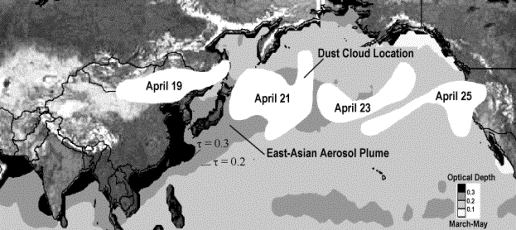
(Source:www.lakepowell.net/asiandust.htm)
While the major
concern of the phenomena is potential public health problems, the dust in extreme cases can also cause economic loss such
as visibility problems for pilots, hindering the operation of precision
machinery and impairing the growth of agricultural products. Nonetheless,
recently some ecologists reported in the journal ¡®Science¡¯ that there might be a positive effect: as observed, ¡°Iron rich dust from the
Gobi Desert fertilized a rapid algae bloom in the North Pacific Ocean
in Spring 2001.¡± However,
there is a huge amount of science and technology left to be done in
order to assess the ecological changes and the downstream effects.
In our last discussion,
SICO (Students for International Cooperation) considered air pollution problems
in Asian countries. The main
focus was a discussion about how one perceive this Asian Dust phenomenon and
how one can use scientific, economic, and political strategies to solve this
problem.